

When I published When California Wine Isn’t California, the response was immediate and revealing. Not because people disagreed on the economics — most didn’t — but because many were unsure what wine labels actually guarantee.
Some assumed “California” allowed flexibility. Others believed “American” was purely symbolic. A few were surprised that imported bulk wine could sit quietly behind familiar domestic branding at all.
That confusion wasn’t a failure of readers. It was the inevitable outcome of a system designed to privilege flexibility over clarity.
Which is why the introduction of AB 1585 matters — not as a silver bullet for the wine industry’s economic challenges, but as a long-overdue correction to a labeling gap that has been doing quiet work for decades.
The distinction that shaped the debate
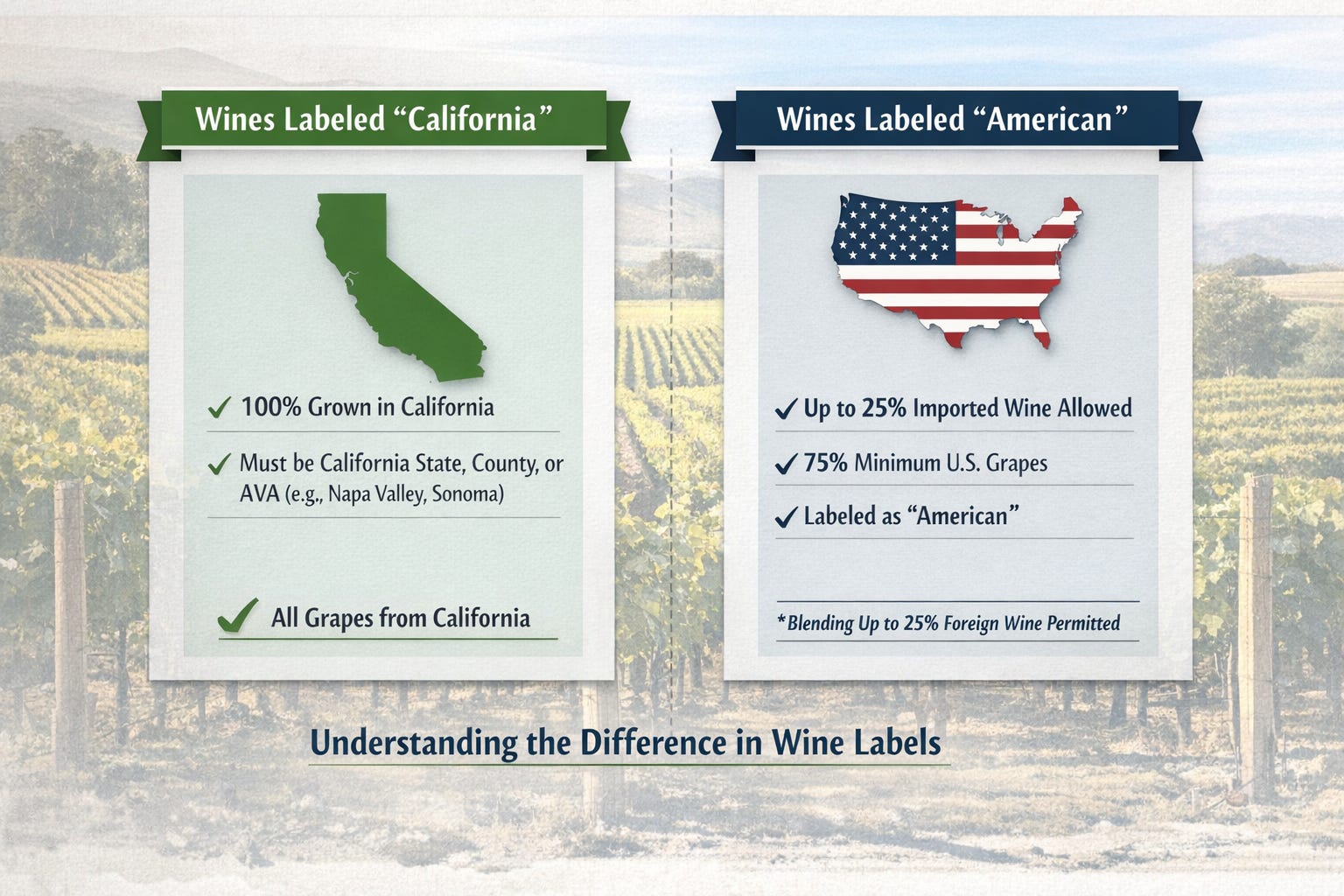
California has long held itself to a higher standard than federal law requires. Wines labeled “California” — or with a California county or AVA — must be made from 100 percent California-grown grapes. That rule is clear, and it has shaped the identity of the state’s wines for generations.
The confusion arises one tier down.
Under existing federal rules, wines labeled “American” may legally contain up to 25 percent foreign wine. That allowance was once marginal. Today, in a market defined by oversupply, cost pressure, and shrinking demand, it has become strategically significant.
What my earlier article documented was not deception, but substitution: imported bulk wine quietly replacing domestic fruit within the legal “American” category, while California growers absorbed the consequences through unrenewed contracts, unpicked fruit, and vineyard removals.
Consumers, meanwhile, assumed “American” meant American-grown. That assumption was reasonable. It was also wrong.
What AB 1585 actually does — and does not do
AB 1585 doesn’t outlaw imports. It doesn’t interfere with blending across regions or states. It doesn’t regulate contracts, pricing, or sourcing decisions.
What it does is simpler, and more consequential: it restores alignment between language and land.
If a wine is labeled “American,” the grapes must be grown in the United States. No asterisks. No fine print. No quiet reliance on consumer assumptions.
In other words, it extends to the national designation the same standard California has applied to itself for decades.
This matters because labels are not marketing poetry; they are informational tools. When those tools drift too far from reality, trust erodes — not loudly, but steadily.
Why this moment, and why now
The timing of this legislation is not incidental. It arrives at a moment when the wine industry is under simultaneous pressure from every direction: declining per-capita consumption, demographic shifts, inventory backlogs, rising interest rates, and a global surplus of wine.
In that environment, flexibility has become survival. Imported bulk wine offers price relief and consistency. For large producers managing national SKUs, it solves immediate problems.
But flexibility without transparency carries a cost — one that has largely been borne by growers.
When sourcing decisions change faster than labels, the economic shock travels downstream. Vineyards are pulled before consumers ever see the cause. By the time questions arise, the system has already moved on.
AB 1585 doesn’t reverse those pressures. What it does is remove ambiguity from the conversation.
This isn’t about protectionism — it’s about coherence
It’s tempting to frame this as a fight between small producers and large ones, or between domestic agriculture and global trade. But that framing misses the point.
Wine is an agricultural product before it is a brand. Its identity is rooted in where grapes are grown, not where logistics are optimized. Labels are meant to communicate that origin, not obscure it.
AB 1585 doesn’t tell wineries how to operate. It simply asks that the words on the bottle reflect the reality in the vineyard.
For consumers who say they value authenticity, that clarity matters. For growers who farm land year after year without guarantees, it matters even more.
A quieter, more honest future
The most telling thing about the response to When California Wine Isn’t California wasn’t the disagreement — it was how many professionals were talking past one another using the same terms to mean different things.
That’s what happens when language drifts.
This legislation is not a moral judgment. It’s a recalibration. A reminder that if wine is grown in the vineyard, labels should honor that fact plainly.
Whether AB 1585 passes or not, the conversation it has sparked is already doing important work. It has made visible what was previously background noise. It has clarified what many assumed but couldn’t quite articulate.
And it has underscored something the wine industry cannot afford to forget: trust, once diluted, is far harder to rebuild than any vineyard.
So this is a bill in the California legislature? How do they define "American" if that's a federal standard? Or would it prevent California wineries from blending imported wine into their "American" wines? (Federal standards are a minimum; states may impose stricter requirements.)